
A Victorian enquiry

At its best the Victorian spirit of enquiry is curious and charitable; at its worst paternalistic and bigoted. Two books by two men display both sides of one of the Victorian periods characteristic features. I used them in my research and they show how vital contemporary writing can be to the historical writer, and also some of the pitfalls.
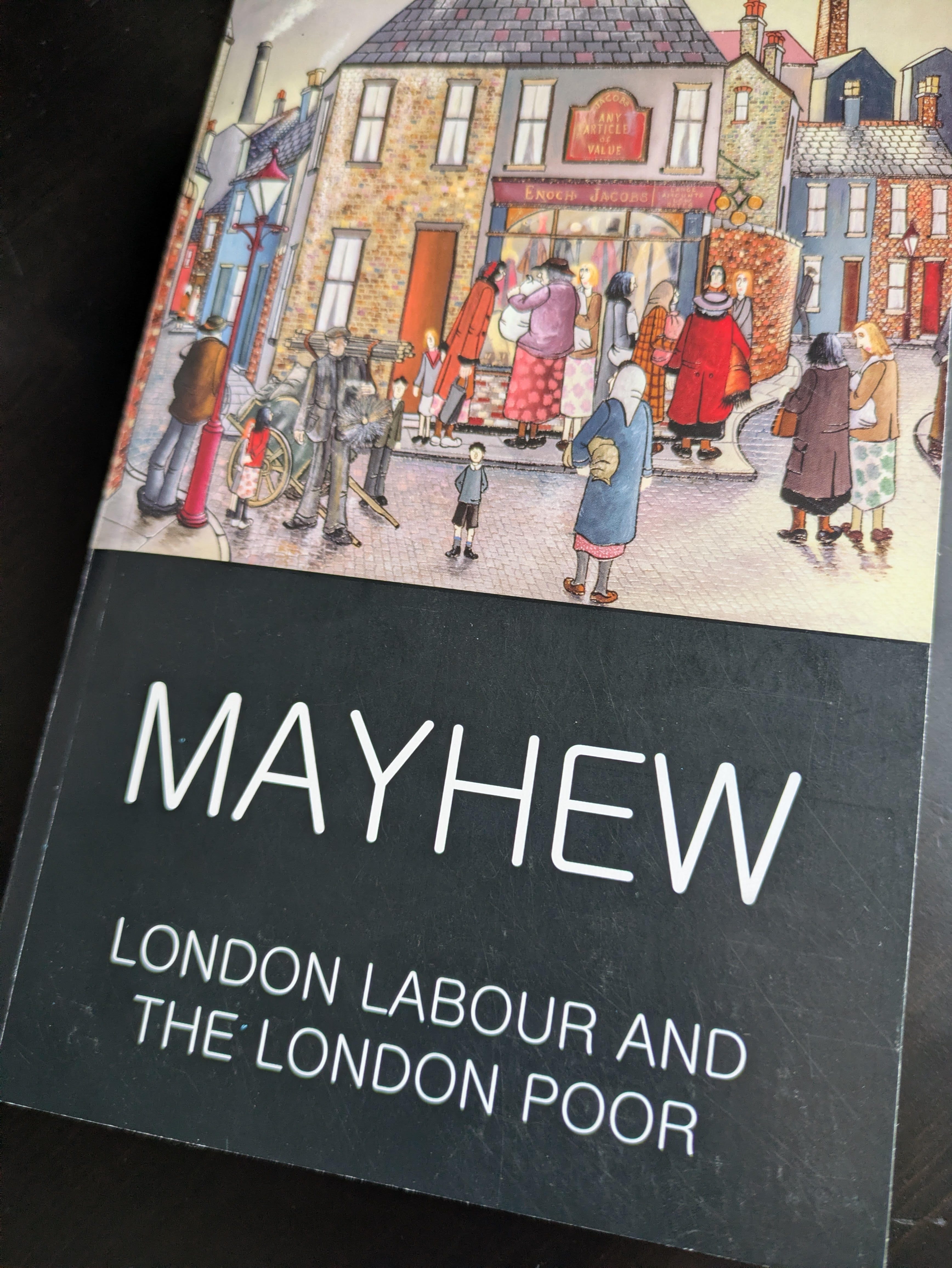
Today I’m going to write about Henry Mayhew’s London Labour and the London Poor, published first as articles throughout the 1840s and later collected into four volumes. Here we find a man who seeks out the people most of society actively avoids, talks to them and records their words. He’s indignant about mistreatment, poor pay and abuse.
The section on dock workers details the end of a particularly abusive system in 1843. Boat owners would also be the owners of taverns along the riverside and the men had to be favoured by the tavern keeper to get work on the boats, which meant they had to spend their (already not generous) wages on drink, rather than the food or rent their families actually needed. According to Mayhew three workers1 had legislation brought forwards to regulate the trade. Can we hear from those men, perhaps? They’re not even named.
Reading any non-fiction it’s worth keeping an eye out for the writer’s biases as well as our own and Mayhew’s are often glaringly obvious. In the section on minorities he writes with surprise about the neatness of the houses of Irish immigrants, goes on to note that they seem ‘listless and lazy’ but that they will ‘perform the severest bodily labour’. He does at least notice the contradiction between those last two observations but goes no further.
As a writer of historical fiction this book is useful both for the information Mayhew conveys and also because it demonstrates the attitudes of even a well-meaning and charitable man of the time; a man whose life was dedicated to a project designed to shine light on the dark corners of his society. Which, I think, in turn tells us something about human nature but that’s outside the scope of a substack post!
If you read ‘Spider, Spider’ you’ll find that some of the action is set on the London streets detailed in Mayhew’s work and it was invaluable in helping to paint that setting and its people - though I had to keep my guard up about letting his stereotypes and attitudes seep in. Modern works like ‘Vagabonds’ by Oskar Jensen helped to calibrate. I think ‘London Labour’ also influenced my well-meaning but weak and wildly misguided Doctor character; it gave me the flavour of Victorian paternalism. He was not based on Mayhew in any way but I think reading this book helped me to understand the mindset.
Next week I’ll write about another great enquirer into the Victorian poor; Charles Booth and his poverty maps.
They were ‘coal-whippers’, a subset of dock workers whose job was to unload coal from the hold of a boat. An especially hard and dangerous job with an evocative name!
I first encountered Mayhew over 20 years ago, I think at the time my enthusiasm for it as a resource made me miss the paternalism (I was studying history of ideas at the time, but as the tutors kept telling me, I kept getting distracted by the social history side). I know very little about Booth and the poverty maps aside from the tiny bits I've seen online.